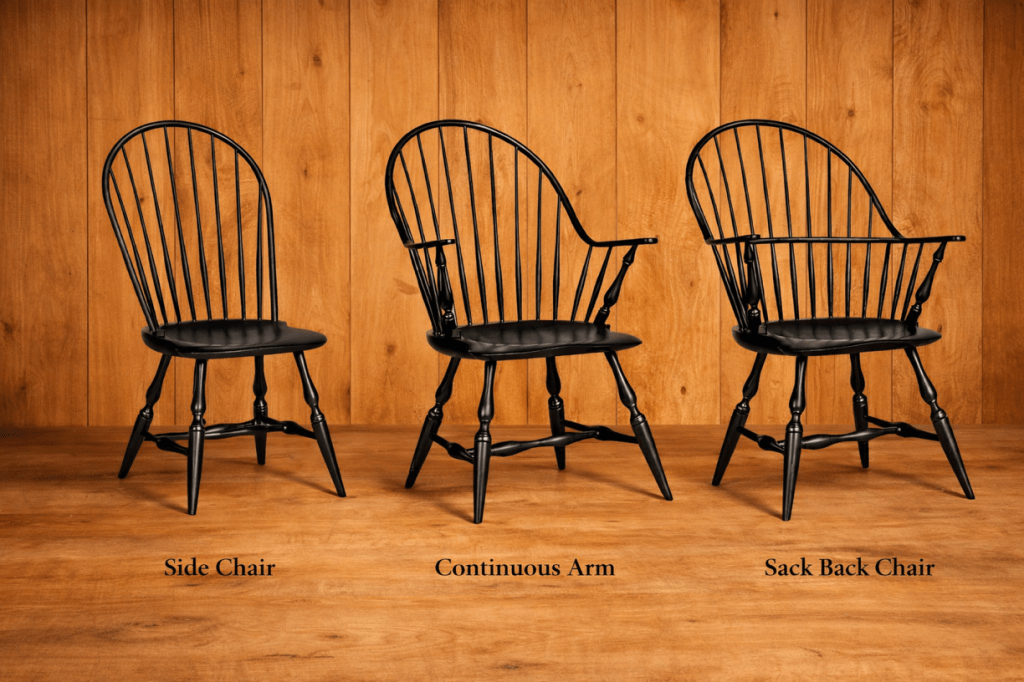
People ask, sometimes, if I am a furniture maker. I tell them no. A furniture maker cuts square corners. I cannot cut a square corner to save my life. That is why I make chairs.
There is a kind of freedom in that admission. Windsor chairmaking is not a craft of straight lines and tight tolerance. It is a craft of found angles, of legs driven into seats at compound rakes that you learn to feel before you calculate. The components of a good Windsor — the turned spindles, the steam-bent bow, the carved saddle seat — exist in deliberate tension with one another. None of it is plumb. All of it holds.
I spent more than fifty years in technology, most of it writing the documentation that explained how things worked. Process manuals, reference guides, the kind of prose that tries to make complicated systems understandable to the people who have to live inside them. That work asked for precision and clarity. So does this. The materials are just more honest about what they want.
The tools I reach for now are a different matter from anything I used in that earlier life. My favorite set of drill bits is antique, a Christmas gift from Jan that she tracked down knowing exactly what I would do with them. The spokeshave I use to fair the back of a seat belonged to someone I will never know. My bodger’s bench — the shaving horse where each spindle begins its life under the drawknife — is a design that has not changed in any meaningful way since craftsmen worked the beech coppices of the Chilterns in the eighteenth century. There is something clarifying about tools that have already outlasted several generations of people who were quite certain their era was the important one. Technology moves fast and changes often. These tools do not move at all. They wait.
The work has its own sounds. I have come to love them in the way you love things that ask nothing of you except attention. The reamer turning into a freshly bored mortise makes a low, clean note as it seats. The spokeshave riding the length of a spindle blank whispers in a register that changes as the taper develops. The drawknife on the shaving horse is more percussive, a conversation between tool and grain. None of these sounds were designed. They are simply what happens when old steel meets new wood.
The Windsor chair came to the American colonies in the early eighteenth century, and what happened next says something interesting about the people who made them. Colonial chairmakers used whatever wood grew nearby. Poplar for the seat, hickory for the spindles, maple for the turned legs, ash for the bent bow. A single chair might be made from four or five different species. This was practical, not careless. Each wood was chosen for what it could do: hickory bends without breaking, maple turns cleanly, poplar carves well under the adze. But the mixed grain and color of all those different woods in one chair looked, frankly, like what it was. So they painted the
That tradition of painting the Windsor has never really stopped. I follow it. Every chair I finish gets a coat of Old Fashioned Milk Paint — the same powdered, water-mixed formula that has been made since 1974 from the same earth pigments and casein base that colonial craftsmen would have recognized on sight. My customers choose from the period colors: Mustard, Federal Blue, Barn Red, Pitch Black.
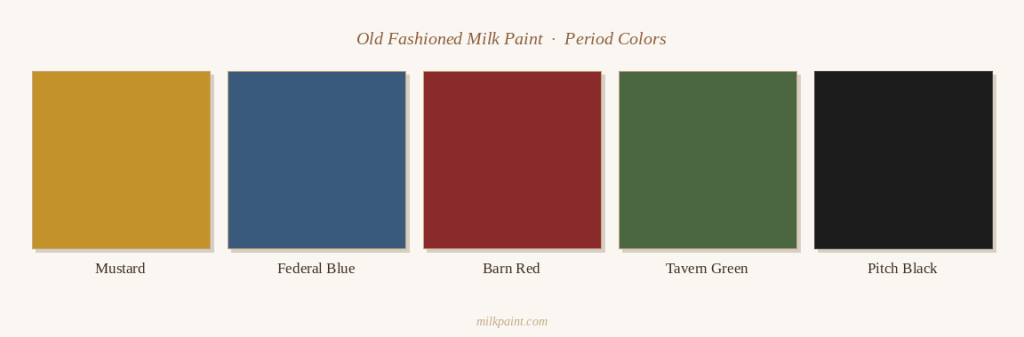
Milk paint dries to a matte, slightly uneven surface that looks exactly like what it is: old. It does not try to be anything else. Under it, the wood continues to do what wood does, and the paint wears accordingly over decades of use. That seems right for a chair that is meant to last.
There is a passage attributed to Zhuangzi — that Alan Watts returned to often in his teaching — that I think about in the shop. It goes something like this:
“When the shoe fits, the foot is forgotten. When the belt fits, the belly is forgotten. When the heart is right, for and against are forgotten.”
Zhuangzi, “Mastering Life” (Chapter 19) – as translated by Thomas Merton in The Way of Chuang Tzu (New Directions, 1965)
That is the best description I have heard of what a Windsor chair does when it is made well. People settle in and stop thinking about where they are sitting. Something releases. The chair disappears into the act of being used, which is exactly what it is for.
A continuous-arm Windsor, a sack-back, a comb-back — whatever the form, people find their place in it. I think this is because a Windsor is not designed around an idealized body. It is designed around a shaped seat, a saddle hollowed and contoured with the travisher and adze to receive weight where weight actually falls. The chair starts from the body rather than from a drawing. That is an old idea. It predates almost everything we now call ergonomics by several centuries, and it works better.
Someone asked me once whether I find it strange, moving from a career of explaining technology to a shop full of tools that predate electricity. I thought about it. Writing documentation was also a practice of working with the grain of things — finding the clearest path through a complicated system and putting it into language a person could follow. The materials change. The patience required does not. What the shop offers that the other work rarely did is the sense that what gets made here might still be in use long after I am not. A well-fitted Windsor, properly dry-mortised and wedged, can serve a family for three hundred years.
Somewhere out in an imagined future, someone I will never meet will pull one of these chairs up to a table, settle their weight into a saddle seat I shaped with a scorp on a slow afternoon in Baker City, and not think about the chair at all. They will think about whatever is in front of them.
The chair will simply hold them. That seems like enough.
Larry


Leave a Reply